

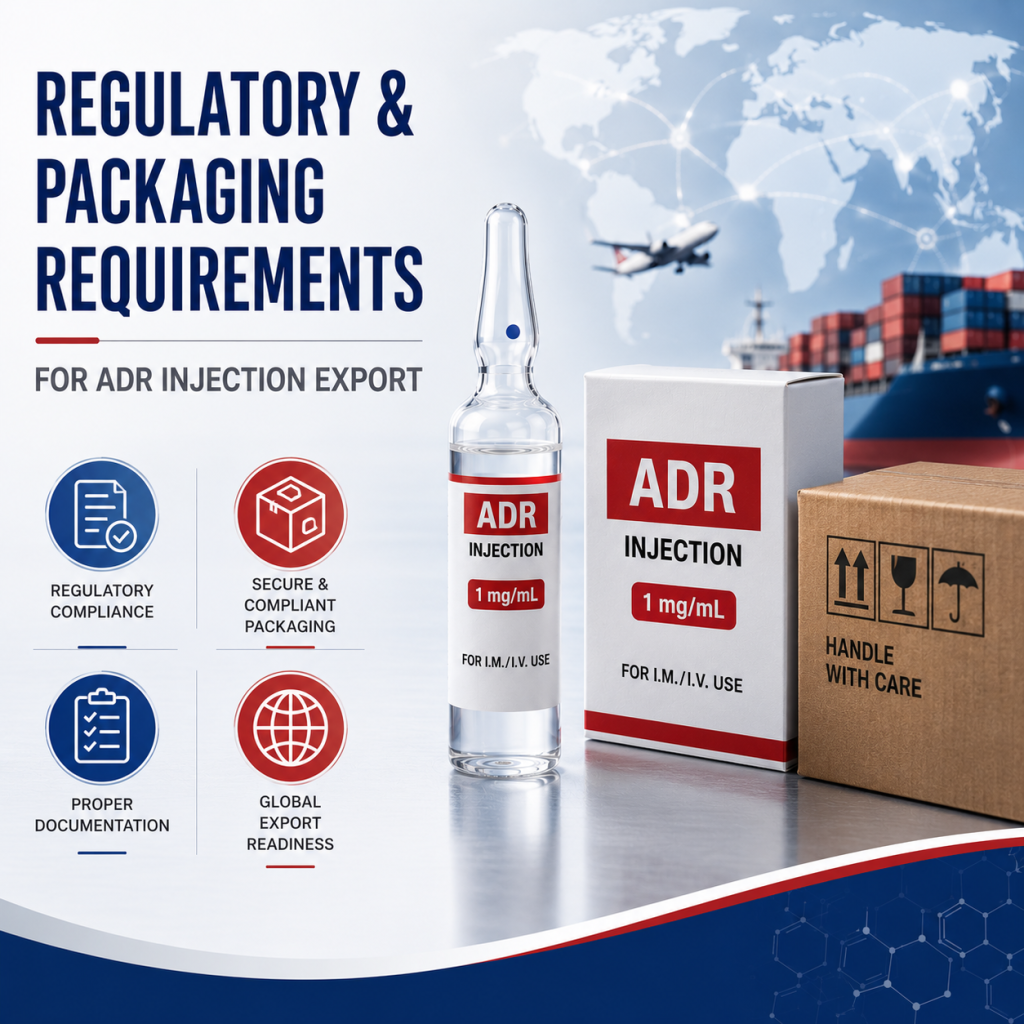
Insulated Shippers: In 2026, bulk exports are often shipped in “Passive Thermal Systems”—insulated containers that maintain a steady temperature of 15°C to 25°C even during transshipment in harsh climates.
For life-saving molecules like adrenaline, every exported batch must carry documented proof that it has been protected from light, oxygen, and thermal stress from factory gate to final destination
Regulatory Compliance: The 2026 Global Passport
Many major international ports now require all permits and “No Objection Certificates” (NOCs) to be digitally integrated into a central blockchain or cloud-based gateway.
Pre-Uploaded Stability Data: Exporters must now pre-upload batch-specific stability data to the customs gateway before the vessel arrives.
Avoiding “Hot-Port” Delays: By having the data available for instant digital audit, you avoid the dreaded “hot-port” delays. If a shipment of adrenaline sits on a sun-drenched tarmac because of a paperwork discrepancy, the 2026 sensors will detect the heat excursion, and the batch may be deemed clinically compromised.
For companies involved in adrenaline injection bulk export, digital regulatory integration is no longer optional—it is mandatory.
Packaging as a Biological Fortress
When we talk about adrenaline injection bulk export, we have to shift our mindset. Packaging isn’t just a box or a vial; it is a biological fortress.
Creating the Micro-Environment
To stop this degradation, we have to control the atmosphere at a molecular level. In 2026, the industry standard has moved toward creating a “suspended animation” environment within the primary and secondary packaging.
The Amber Defense: We use Type Borosilicate Amber Glass. It’s not just about the color; it’s about the specific light-transmission curve. The amber glass acts as a surgical filter, blocking the exact UV wavelengths that trigger the molecular “flip” in the epinephrine structure.
Nitrogen Displacement: Oxygen is the primary enemy.
Sealed Secondary Box Ambient Humidity Protects the label and the glass from moisture-induced mold.
By viewing packaging as an active part of the medicine’s efficacy, you aren’t just shipping a product; you are guaranteeing a clinical outcome. When that ampoule is snapped open six months later in an emergency room half a world away, the fact that the solution is crystal clear is a direct result of the micro-environment you built. Adrenaline oxidizes rapidly—turning pink or brown as it transforms into inactive adrenochrome.
Primary Packaging: The Amber Shield
Because adrenaline is highly photosensitive, Type I Amber Glass Ampoules or Vials are the industry standard. The amber tint filters out specific UV wavelengths that trigger the “flipping” of the molecule into its inactive form.
Nitrogen Sparging: during the filling process, the headspace of each ampoule is purged with nitrogen. This removes oxygen, the primary catalyst for the browning effect.
Secondary and Tertiary Packaging
In the high-velocity logistics of 2026, the vulnerability of Adrenaline isn’t just chemical—it’s physical.
The Evolution of the “Tray Pack”
Standard bulk packing—where ampoules are loosely bundled—is no longer the industry standard for international air freight.
If the secondary packaging fails and the ampoules are shaken or exposed to light, that 1 mg/mL concentration can begin to drift.
Ultimately, by investing in rigid, slot-based secondary packaging, you are ensuring that your bulk supply doesn’t just arrive at its destination—it arrives in “factory-fresh” condition, ready for the emergency room where every milligram counts.
Cold Chain & Real-Time Monitoring
IoT Traceability: bulk pallets are now equipped with IoT sensors that provide real-time data on temperature, humidity, and light exposure. If a container sits on a tarmac in 40°C heat, the exporter receives an instant alert.
Thermal integrity plays a decisive role in adrenaline injection bulk export logistics. Even though the product is labeled for storage below 25°C, prolonged exposure to elevated temperatures during air freight or port congestion can accelerate oxidation. Advanced exporters now combine insulated shippers, data-logging IoT sensors, and predictive route mapping to ensure uninterrupted environmental control throughout transit.
Ultimately, excellence in adrenaline injection bulk export is defined by proactive risk management. From nitrogen-purged ampoules to rigid tray-based secondary packaging and digitally monitored transport lanes, every layer acts as a safeguard against potency drift. In emergency medicine, consistency is not a commercial advantage—it is a moral obligation.
The “Trust-Efficacy” Loop in Critical Care
In the world of emergency medicine, there is zero room for “potency drift.” A paramedic reaching for an adrenaline ampoule in 2026 expects it to be clear and active. As an exporter, your value lies in the integrity of the seal.