

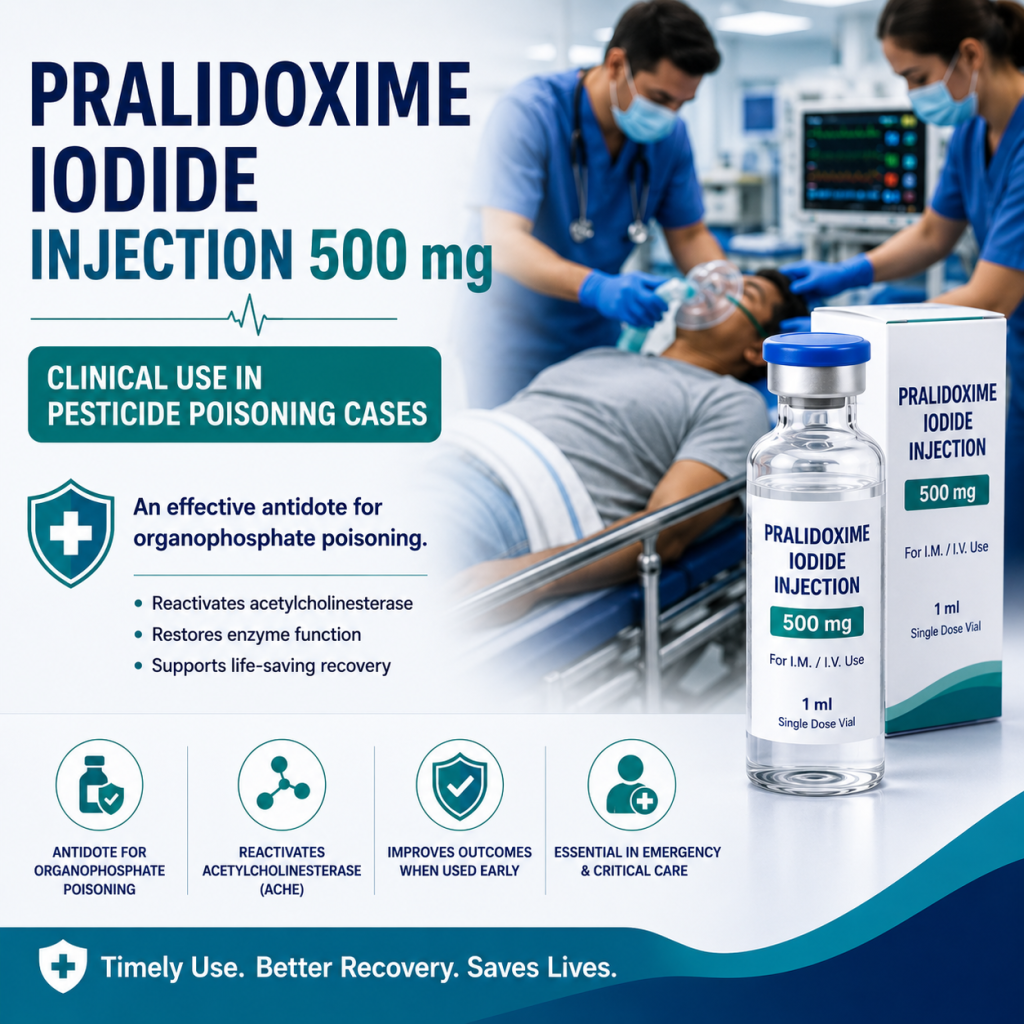
In an emergency room, time feels different. It tightens. Every second carries weight. When a case of organophosphate poisoning comes in, that pressure becomes almost physical. The room shifts from routine to urgency in an instant.
These poisons don’t just harm the body in a general way. They interfere with the signals that keep a person alive. Muscles begin to fail. Breathing becomes shallow, then strained, then dangerously close to stopping. It’s not dramatic in the way people imagine. It’s quieter, more unsettling. A body slowly losing its ability to respond.
A chance to interrupt what the poison has set in motion. It works by restoring the function of an enzyme that the toxin has blocked, helping the nervous system find its voice again.
You can see the stakes in the smallest changes. A patient who couldn’t lift their chest suddenly draws a deeper breath. Muscles that were rigid or unresponsive begin to ease. It doesn’t feel like a miracle. It feels like something being given back.
There’s a quiet kind of relief in those moments. Not celebration, not yet. Just a shift from fear toward possibility.
In environments like these, medicine isn’t abstract. It’s immediate, human, and deeply fragile.
The Mechanism of Neural Rescue
This leads to a continuous, overwhelming electrical storm in the muscles and glands. Pralidoxime acts as a molecular “chisel.” It reaches the site of the enzyme-pesticide bond and physically breaks it, liberating the enzyme so it can resume its essential work.
In 2026, clinicians emphasize the “window of opportunity.” If Pralidoxime is administered before the enzyme-pesticide bond “ages” and becomes permanent, the reversal of paralysis can be near-miraculous. This is why the 500 mg injection is a mandatory component of emergency kits in farming communities and industrial centers worldwide.
Clinical Guidelines and the Human Protocol
Administering Pralidoxime Iodide Injection 500 mg requires a balanced, human-centered approach. It is rarely a standalone therapy; it works in a critical partnership with Atropine. While Atropine dries the secretions and settles the heart, Pralidoxime addresses the underlying cause of the muscle weakness itself.
Ensuring Purity: The Pralidoxime Iodide 500 mg Injection Manufacturer
Producing an antidote is a matter of profound ethical significance. Manufacturers in this specialized sector utilize high-grade synthesis and purification technologies to ensure that the active iodide salt is free from impurities that could complicate an already critical clinical picture.
High-tier manufacturers now employ “Real-Time Stability Testing” and advanced lyophilization (freeze-drying) processes.
The Role of Global Distribution and Bulk Supply
for a rural clinician, having this antidote within reach changes everything. It replaces helplessness with action. It allows them to respond immediately, to stabilize, to give someone a real chance before referral becomes necessary. Because in the end, it’s not just about treating poisoning. It’s about standing with those who feed the world, and making sure that when they need help, it finds them without delay.
A Legacy of Survival and Recovery
It is not just a treatment kept behind glass in emergency wards. It is something far more human. It exists for the moments when time tightens, when breathing becomes uncertain, and when a life hangs delicately between what was and what could still be.
For a farmer exposed in the fields, or a child caught in an accidental moment, the experience of poisoning is sudden, disorienting, and deeply frightening. The body forgets its own rhythm. Muscles weaken, breaths shorten, and the world narrows. And then, quietly, intervention arrives—not as noise or spectacle, but as intention.
Pralidoxime does something remarkable. It doesn’t just manage symptoms; it helps restore what was disrupted. It gives the body a chance to remember how to function, how to breathe, how to respond. And in that restoration, there is something profoundly reassuring—not just medically, but emotionally.