

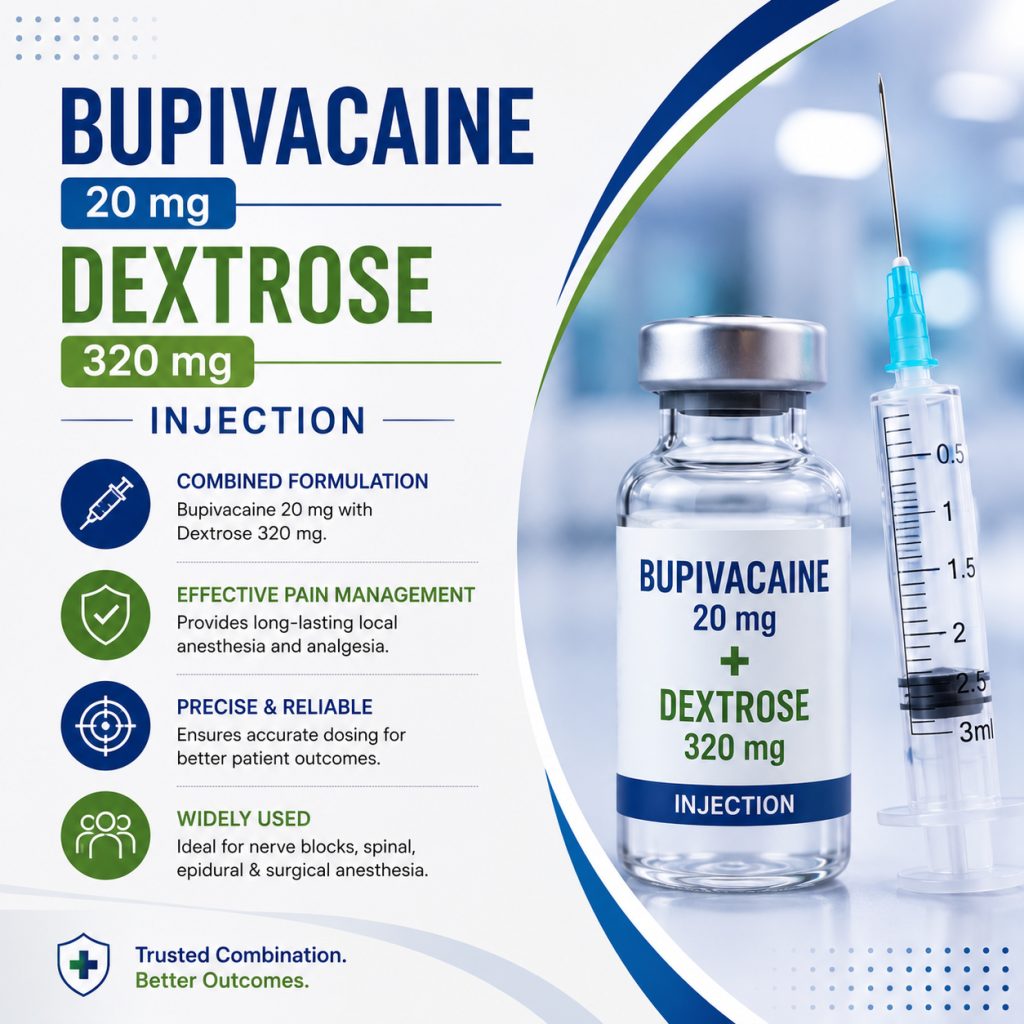
In the sophisticated surgical environment of 2026, the Bupivacaine 20 mg and Dextrose 320 mg injection stands as a masterpiece of pharmacological gravity. Known colloquially among anesthesiologists as a “Hyperbaric Solution,” this combination is far more than a simple anesthetic; it is a precision-engineered tool that allows clinicians to “map” the boundaries of pain during some of life’s most significant moments—from the arrival of a new child via Cesarean section to life-restoring orthopedic surgeries.
The Science of “Heavy” Anesthesia
The true brilliance of this injection lies in the relationship between its two components. In 2026, we have perfected the use of Dextrose (320 mg) not as a nutrient, but as a weighting agent. By making the solution “hyperbaric”—meaning it is denser and heavier than the natural cerebrospinal fluid (CSF) in the spine—anesthesiologists can use gravity to dictate where the numbing effect settles.
Gravity-Guided Precision: When injected into the subarachnoid space, the dextrose ensures the Bupivacaine (20 mg) “sinks” or “travels” based on the patient’s physical position. This allows for a surgical block that is perfectly tailored to the procedure: lower for limb surgery or higher for abdominal work.
The Amide Advantage: Bupivacaine, a long-acting amide anesthetic, works by temporarily “silencing” the sodium channels in nerve fibers. This prevents pain signals from ever beginning their journey to the brain, providing 2-3 hours of profound surgical stillness and peace.
A Human-Centered Surgical Experience
Beyond the chemistry, the use of this injection in 2026 is defined by the Human-in-the-Loop care model. Choosing to undergo surgery is never just a medical decision; it is a profound act of trust.
This allows the surgical team to move forward with precision and gives the patient immediate relief from preoperative anxiety.
Predictable Recovery: By using a measured dose, we ensure that the “wake-up” process for the lower body is as steady and gentle as the onset.
Patient-Centric Precision: Every milligram is accounted for to balance absolute intraoperative stillness with postoperative mobility.
Why the 20 mg Dose Matters.
Post-Operative Grace: One of the most valued aspects of Bupivacaine in 2026 is the “analgesic tail”—the period after the motor block wears off but the pain relief remains, allowing patients to wake up or recover without the jarring immediate onset of post-surgical pain.
2026 Manufacturing and Safety Standards
The integrity of a spinal injection is absolute. Because this medicine is delivered directly into the central nervous system, there is no room for error.
The Ethics of the Block
Ultimately, the Bupivacaine 20 mg and Dextrose 320 mg injection is a symbol of how far we have come in our ability to care for the human body during its most vulnerable states. Surgery has always been one of the most vulnerable moments a human being can face. For decades, the cold, clinical steel of the operating room was synonymous with a sharp, instinctive fear. But as we move through 2026, that narrative is shifting. We are entering an era where the bridge between illness and recovery isn’t built on trauma, but on a foundation of profound clinical empathy.
The philosophy is simple: healing should never begin with a hurt.
The New Standard of Care
We have moved past the era of “putting someone under” as a blunt necessity. Safety is the baseline; dignity is the goal.
A Vision of Compassionate Science
In this landscape, the “drug” is merely a tool. The real work lies in the synergy between the hands that create the medicine and the hands that administer it. When we eliminate the specter of pain, we allow the patient to focus their entire biological energy on what matters most: recovery.
“We are no longer just treating a condition; we are safeguarding a human experience. Modern surgery is a testament to what happens when we prioritize the quiet peace of the patient as much as the success of the procedure.”
By weaving together expert clinical application and a deep respect for the human spirit, we’ve turned the operating room into a space of quiet transformation. It is no longer a place to be feared, but a place where the journey home truly begins.