

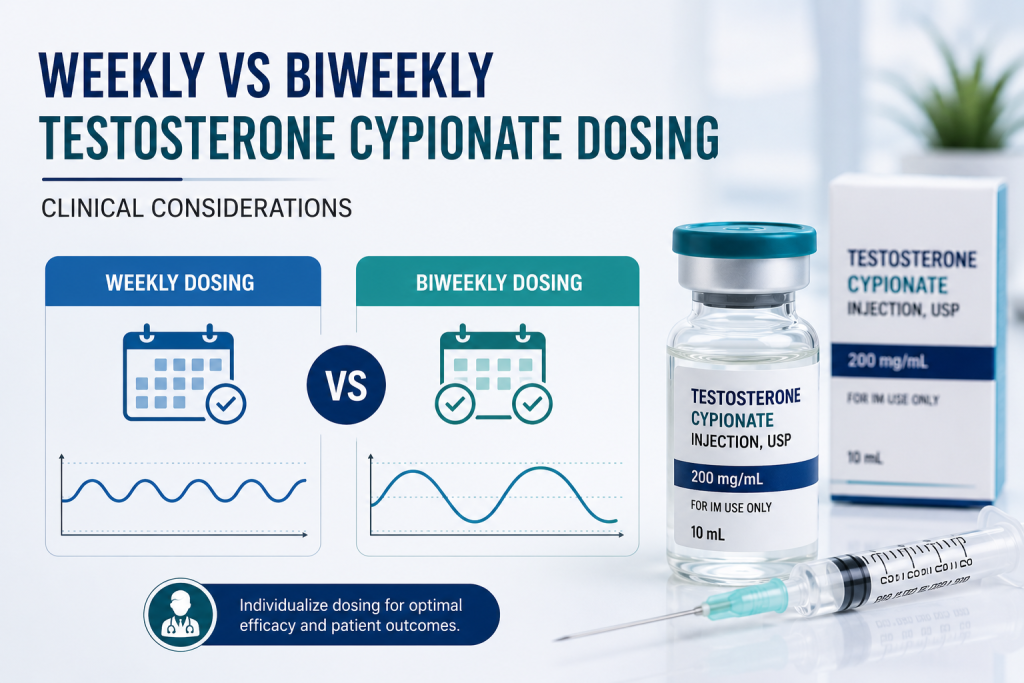
While this “twice-a-month” schedule looked efficient on a doctor’s calendar, it often ignored the lived reality of the man receiving the treatment. Biweekly dosing creates a dramatic “peak and trough” cycle—a hormonal rollercoaster where you feel like Superman for the first few days, only to spend the final week sliding into a “crash” of fatigue, irritability, and brain fog. It was a system that prioritized the clock over the human experience.
By moving toward Weekly or even Twice-Weekly dosing, we can smooth out those metabolic valleys. This isn’t just about avoiding a bad mood; it’s about mimicking the body’s natural, steady rhythm. When your levels stay consistent, your body isn’t constantly trying to recalibrate, leading to better sleep, more stable energy, and a significant reduction in the unwanted “spikes” of estrogen that large, infrequent doses can trigger. However, as our understanding of human physiology and “hormonal well-being” has matured, we’ve realized that what is convenient for a clinic is rarely what is optimal for a man’s daily life. Choosing between Weekly vs. Biweekly Testosterone Cypionate dosing is no longer just a logistical decision; it is a clinical consideration that directly impacts mood, energy, and long-term metabolic health.
The Half-Life Challenge: Solving the “Rollercoaster”
To understand why dosing frequency matters, we have to look at the chemistry of the Cypionate ester. In 2026, we recognize that the half-life of this specific ester is approximately 7 to 8 days.
By day 10, his serum testosterone levels have often plummeted below the therapeutic range. This creates a “rollercoaster” effect: the first few days feel like a surge of energy and libido, followed by a slow, agonizing slide into fatigue, irritability, and “brain fog” as the next dose approaches.
The Case for Weekly Dosing: Stability as a Standard
In 2026, Weekly Dosing has become the gold standard for men seeking a “stable” human experience. By cutting the dose in half and doubling the frequency, we significantly narrow the gap between the “peak” and the “trough.”
This stability offers profound clinical benefits beyond just feeling better. When testosterone levels spike too high—which often happens with large, biweekly bolus injections—the body reacts by increasing Aromatization. This is the process where excess testosterone is converted into Estradiol (E2). High estrogen in men can lead to water retention, mood swings, and even the development of breast tissue (gynecomastia). By moving to a weekly (or even twice-weekly) schedule, we keep the peaks lower, reducing the need for “ancillary” medications like aromatase inhibitors, which carry their own set of side effects.
Key Clinical Comparisons
Secondary Hormones: Stable testosterone levels help maintain a better balance of **SHBG (Sex Hormone-Binding Globulin)** and DHT, ensuring the “free” or usable testosterone remains consistent.
The “Human” Factor: Compliance and Quality of Life
The primary argument against weekly dosing used to be “injection fatigue”—the idea that men wouldn’t want to pin themselves every seven days. Most men find that the five minutes it takes to administer a weekly dose is a small price to pay for 168 hours of consistent, high-quality life.
For the clinician and the brand owner, the focus in 2026 is on Subjective Well-Being. We no longer just treat the “total testosterone” number on a lab sheet; we treat the man. If a patient feels “empty” or “flat” by the second week of a biweekly protocol, that protocol has failed him, regardless of what his blood work says. Weekly dosing allows for a “set it and forget it” mental state, where the medication becomes a quiet background support rather than a biweekly event that dictates his mood.
Purity and Carrier Oil Integrity
In 2026, we also consider the Carrier Oil used in the Testosterone Cypionate formulation. Frequent injectors often prefer thinner oils like MCT or Grapeseed Oil (GSO) over the traditional, thicker cottonseed oils. These modern carriers allow for faster injection times and reduced localized inflammation (PIP – Post Injection Pain). Ensuring that the medication is housed in Multi-Dose Vials (MDV) with high-integrity rubber stoppers is essential for those on a weekly schedule to prevent contamination and ensure every dose is as sterile as the first.
Ultimately, the choice between weekly and biweekly dosing is about reclaiming the “Middle Ground.” We move away from the “Superman to Clark Kent” cycle and toward a version of masculinity that is steady, reliable, and resilient. In 2026, we don’t just want you to be “on TRT”—we want you to be your best self, every single day of the week.