

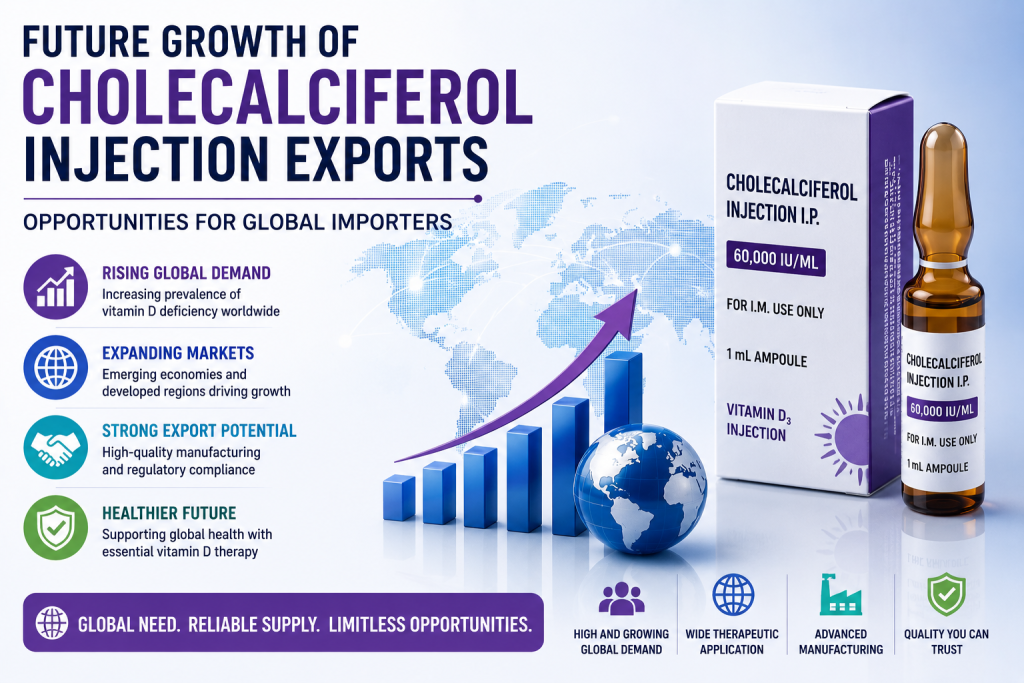
The future growth of cholecalciferol injection bulk exports is not just a story of numbers, factories, and shipping containers, it is a deeply human story rooted in a silent global deficiency that touches almost every family at some point in their lives. Vitamin D deficiency does not announce itself loudly; it creeps in through persistent fatigue, aching bones, weakened immunity, delayed healing, and in older adults, the frightening risk of fractures that can change the course of independence forever. For millions of patients who cannot absorb oral supplements properly or who need rapid correction of severe deficiency, cholecalciferol injections become more than a product – they become a lifeline. This emotional reality is driving sustained and accelerating demand worldwide, making the export landscape for cholecalciferol injections one of the most promising opportunities in the pharmaceutical trade over the coming decade.
Across continents, lifestyles are changing in ways that reduce natural vitamin D synthesis. Urbanization, indoor jobs, heavy sunscreen use, air pollution blocking UVB rays, and cultural clothing practices have all combined to create a generation that spends more time under artificial lights than under the sun. From Northern Europe to the Middle East, from South Asia to Latin America, clinicians are reporting rising cases of deficiency not only among the elderly but also among pregnant women, young professionals, and even children. When deficiency becomes severe, oral tablets are often too slow or unreliable, especially in patients with malabsorption, liver disorders, obesity, or chronic kidney disease. This is where cholecalciferol injections take center stage, offering rapid replenishment and predictable bioavailability. Global importers are beginning to understand that this is not a niche therapy anymore; it is becoming a routine component of modern care protocols.
Healthcare systems are changing in quiet but important ways that naturally support the use of injectable vitamin D. Care today is more structured and protocol-based. In many hospitals, intramuscular cholecalciferol is no longer an exception. It’s part of standard treatment for patients who are most at risk. Geriatric centers rely on it to protect fragile bones. Dialysis units use it to manage complex deficiencies. Orthopedic teams see it as a support for recovery. Maternal health programs turn to injections to give both mothers and infants a stronger start.
In many developing regions, governments are also taking vitamin D deficiency seriously. Public screening programs are expanding, and with testing comes diagnosis at a scale that wasn’t possible before. Every new screening effort sets off a chain reaction. More patients are identified, more treatments are prescribed, and the need for dependable, affordable injectable options grows.
For exporters, this moment is unusual. Clinical necessity, government policy, and real patient benefit are moving in the same direction. Together, they form a steady, long-term growth path that isn’t driven by hype and shows no sign of slowing down.
Losses that once seemed inevitable are now preventable, and shelf life can be trusted even after weeks in transit.
Because of this, exporters who once held back from serving distant or difficult markets are rethinking their reach. Supplying rural clinics in parts of Africa, island nations in the Pacific, or remote regions of Central Asia is no longer a gamble. It’s becoming a realistic and sustainable option. For importers, this shift opens doors that were closed for years. Treatments that were once hard to source or inconsistent are now arriving on time and in usable condition.
Every new clinic or hospital that becomes reachable is more than a line on a sales report. It’s a place where patients can finally receive care when they need it, not months later or not at all.
What makes this growth story truly compelling is the emotional undercurrent that runs through it. Behind every bulk shipment is a story of a grandmother who can walk without pain again, a new mother whose exhaustion finally lifts, a construction worker who regains the strength to earn a living, a child who grows without the shadow of bone deformities.
As long as these simple hopes sit at the center of healthcare, injectable vitamin D will continue to matter. And the exporters and importers who respect that purpose won’t just find business success.