

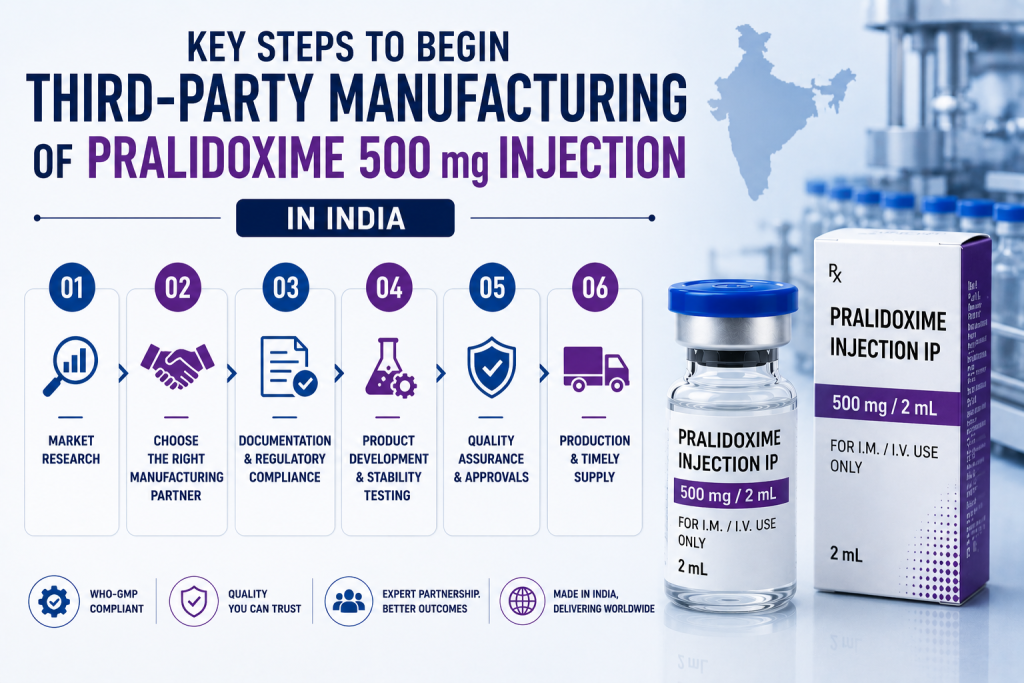
Once the legal frame is in place, the heart of the process is the selection of a manufacturing partner who doesn’t just have the capacity, but possesses a genuine “sterile culture.” You are looking for a facility with WHO-GMP certification and advanced aseptic lines specifically designed for small-volume parenterals. This step is followed by a transparent documentation and agreement phase, where you finalize the “Quality Agreement”—a handshake on paper that defines exactly who is responsible for every test and every vial.
Entering the market with a molecule like Pralidoxime 500 mg Injection is not just a commercial decision, it is a moral one. This is not a product that sits quietly on a pharmacy shelf; it exists for the worst moments, when organophosphate poisoning leaves doctors racing against time and a single vial can mean the difference between life and death.
In a country where this drug is often used in rural hospitals and emergency wards, stability, purity, and dose accuracy are not technical checkboxes, they are promises made to physicians and patients alike. Compliance with Schedule M, robust documentation, and proven expertise in small-volume parenterals are what give real confidence that the 500 mg dose will perform exactly as intended under pressure. While Pralidoxime may never be a high-volume product, it carries strategic weight, quietly shaping a company’s reputation as one that stands on the front line of critical care.
The very first step begins with understanding the product and its responsibility. This awareness should guide every decision you make—from choosing a manufacturer to designing packaging. This sense of responsibility builds the foundation for a trustworthy brand in the long run.
Following technical alignment, regulatory approvals and product registration take center stage. Labels must comply strictly with Indian regulations, mentioning composition, storage conditions, schedule warnings, batch details, and manufacturer information. Attention to detail at this stage reflects professionalism and reduces the risk of rejections or revisions.
Samples are tested for sterility, pyrogen levels, assay, pH, particulate matter, and stability. Observing how the manufacturer handles deviations, investigations, and corrective actions during these batches gives you real insight into their quality culture.
Equally important is packaging and presentation. In injectables, packaging is not just about looks—it is about protection, clarity, and trust. Hospitals and doctors value products that are easy to handle in emergencies.
As the product reaches the market, post-launch vigilance becomes essential. Batch traceability, complaint handling, and recall readiness are not optional—they are responsibilities that come with manufacturing life-saving medicines. A strong third-party manufacturer will support you in documentation, investigations, and regulatory communication if required.
Over time, you may explore tender supplies, exports, or capacity expansion. When both parties grow together with transparency and mutual respect, third-party manufacturing becomes not just a business arrangement, but a dependable alliance.
In conclusion, beginning third-party manufacturing of Pralidoxime 500 mg Injection in India is a structured yet human-centered process. It requires regulatory knowledge, technical understanding, careful partner selection, and above all, respect for the lives that depend on the product.